Psychological Research in Management

Psychological Research in Management

Number of Volumes 12
Number of Issues 28
Number of Articles 188
Number of Contributors 427
Article View 857433
PDF Download 559,359
View Per Article 4560.81
PDF Download Per Article 2975.31
 
Acceptance Rate (2023) 25
Time to Accept (Days) 91
Number of Indexing Databases 14
Number of Reviewers 187
Journal Features
  • Year of publication: 2015
  • Specialized area: Psychological studies in organization and management
  • Type of articles that can be published: Research articles 
  • Publication status:  Printed and electronic
  • Country of publication: Iran  
  • Publisher: Hazrat-e Masoumeh University
  • Frequency of publication: Quarterly
  • Number of articles in each issue: At least 6 articles
  • Publication language: Farsi (English abstract)  
  • Type of reviewing:  Double-anonymous reviewing and at least two reviewers
  • Reviewing time: 1-2 months
  • Initial review period: 7 (Working days)
  • Citation method:  APA 7th edition (2020)
  • Publication email: prm@hmu.ac.ir
  • Status of access to the full text of the articles:  Open access and free download
  • The Article Processing Charegs: Yes (https://jom.hmu.ac.ir/journal/about?lang=en)
Follow us: 


Psychological Researches in Management is an open access double-blind peer-reviewed publication which is published by Hazrat-e Masoumeh University.  This journal is a quarterly publication, which publishes original research papers on journal scope.  This journal follows Committee on Publication Ethics (COPE) and complies with the highest ethical standards by ethical laws. All submitted manuscripts are checked for similarity through Samim Noor software to ensure their authenticity and then rigorously peer-reviewed by expert reviewers. (Read More about the journal...).


When submitting the article, please upload the Author's Commitment and authors' conflict of interest forms according to the description of the "Guide for Authors" section.


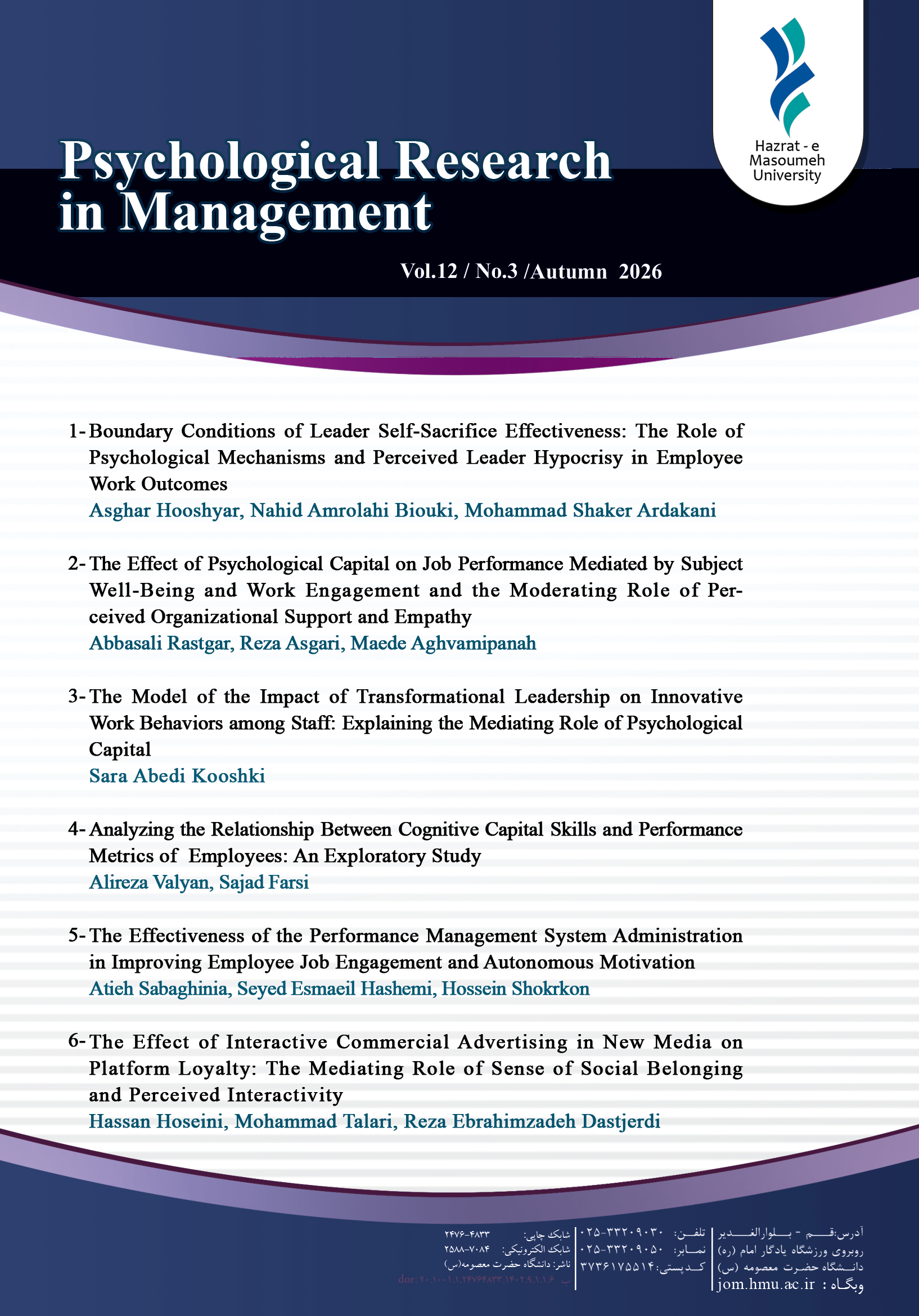
Current Issue: Volume 12, Issue 3, Autumn 2026 

Keywords Cloud

  • Psychological capital
  • Psychological Empowerment
  • Organizational Commitment
  • Organizational citizenship behavior
  • Organizational Silence
  • emotional intelligence
  • self-efficacy
  • Job performance
  • Leadership
  • Social Capital
  • Transformational Leadership
  • Performance
  • Organizational climate
  • Job Burnout
  • Mindfulness
  • grounded theory
  • Job Satisfaction
  • Defensive silence
  • Perfectionism
  • Phenomenology
  • Organizational learning
  • Perceived Organizational Support
  • Organizational innovation
  • narcissism
  • teachers
  • Organizational Culture
  • Coaching
  • Job stress
  • Organizational Cynicism
  • Government Organizations
  • education
  • Trust
  • Efficiency
  • Deviant Behaviors
  • power
  • Knowledge sharing
  • Public Organizations
  • Knowledge-Based Human Resource Management
  • resilience
  • human resource management
  • empowerment
  • turnover intention
  • Work Engagement
  • Optimism
  • Anxiety
  • intellectual capital
  • Behavioral Factors
  • Conscious silence
  • Emotion management
  • self-control
  • Quality of Work Life
  • Motivation
  • Higher Education
  • organizational health
  • social security organization
  • Ethical leadership
  • mental health
  • Job well-being
  • Workplace incivility
  • fuzzy cognitive map
  • human capital
  • psychological well-being
  • Self-censorship
  • aggression
  • Toxic leadership
  • Counterproductive Work Behavior
  • Organizational trust
  • Abusive Supervision
  • Behavioral finance
  • Organizational Justice
  • Content Analysis
  • Interpretive Structural Modeling (ISM)
  • Rumination
  • Citizenship Behaviors
  • Subjective well-being
  • retaliatory behaviors
  • Career Adaptability
  • Employees Mental Health
  • Melli Bank
  • Work outcomes
  • Undesirable Behaviors
  • Diener scale
  • Internal factors
  • Collective atmosphere
  • Neuroleadership
  • Dark Networking
  • Electronic Sales
  • productivity
  • coaching leadership
  • Job Independence
  • Misbehavior
  • Existential dimensions
  • Ideation
  • Call Center Operators
  • Postmodern change management
  • cognitive decision-making
  • Acquiescent silence
  • Solution-focused narrative therapy
  • Mining and Trade Organization of North Khorasan
  • political skill
  • elementary school teachers
  • perceived interactivity
  • Mashhad National Oil Products Distribution Company
  • Tabriz International Airport
  • Sales
  • government organization
  • Occupational performance
  • Imam Hossein (AS)
  • Digital competency development challenges
  • Psychological entitlement
  • Sales manager support
  • Free will
  • Organizational wisdom
  • risk taking
  • Employee Engagement
  • internal locus control
  • ‎Management meritocracy
  • Job elevation sickness
  • Brand-oriented human resources
  • Willingness to turnover
  • Psychological Empowering
  • social intelligence
  • knowledge-based organizations
  • Emotional avoidance
  • Coping styles
  • future operating performance of companies
  • Job Self-Efficacy
  • Berlin Paradigm
  • Interpersonal Relationships
  • Hypertension addiction
  • perfectionismm
  • Tehran municipality
  • happiness in the workplace
  • Basic Psychological Needs
  • Cognitive Model
  • Workplace gossip
  • Keywords: psychological capital
  • Affective-collective investment
  • Job ambiguity
  • Emotional Exhaustion
  • Job distress
  • graduate students
  • Self-regulated learning mechanisms
  • Municipal staff
  • Customer Interest
  • employee resilience
  • early maladaptive schemas
  • spiritual intelligence
  • Silence
  • Behavioral Interest
  • creativity
  • financial decision-making
  • Shopping experience
  • Organizational interactions
  • psychological safety
  • Human Resource Practices
  • psychology
  • laissez-faire Leadership
  • sense of social belonging
  • Emotional focus
  • High performance work systems (HPWS)
  • Military Management
  • turnover Employee Loyalty
  • salespeople
  • Behavioral bias
  • students
  • Genre of movie
  • Service center of Hawza
  • Physical Strength
  • Patriarchal leadership
  • customer anger
  • Auditors
  • Intelligence
  • Ashura
  • Banking
  • HPI
  • Entrepreneurial Passion
  • Political Behavior
  • cost
  • Sharif University of Technology
  • University of Ilam
  • self-sabotage behaviors
  • Cognitive Bias
  • Outgoing Innovation
  • Extra-Role Behavior
  • Ambiguity tolerance
  • HDI
  • Sales Performance
  • Cognitive liveliness
  • Mostazafan Foundation
  • sustainable employability
  • Perceived leader hypocrisy
  • attitudes
  • Repetitive Transcranial Magnetic Stimulation (rTMS)
  • complexity of governance
  • Aras Seghi technique
  • Bibliometric analysis
  • Crisis
  • DEMATEL
  • Ilam hospitals